ADVERTISEMENTS: (c) Lewis (A) Views of Rosenstein Rodan: In 1943 article, Rosenstein Rodan propounded this theory but without using the term balanced growth. He stated that the Social Marginal Product (SMP) of an investment is different from its Private Marginal Product (PMP). If different industries are planned accordingly to their SMP, the growth of the economy would be much more than it the industries had been planned according to their PMP. SMP is greater than PMP because of the complementarity of different industries which leads to the most profitable investment from the social point of view. He illustrates it with a popular example to shoe factory. If a large shoe factory is started in the region where 20,000 unemployed workers are employed.
It was Fredrick List who for the first time put forward the theory of balanced growth. Theory of Balance Growth: Concept, Definition and. File Share Your PDF.
Now in case, the workers spend their entire wages on shoes, it would create market for shoes. If series of industries are started, in that case the demand of different industries would increase via multiplier process. This would lead to planned industrialization. Ragnar Nurkse has also developed his thesis on these lines. ADVERTISEMENTS: (B) Views of Ragnar Nurkse: Prof. Nurkse has given a proper explanation of the theory of balanced growth.
He holds that the major obstacle to the development of the underdeveloped countries is the vicious circle of poverty. This vicious circle of poverty shows that income in underdeveloped countries is low. Low income leads to low savings. Low savings will naturally result in low investment, which will result in less production.
Low production will generate low income. Low income will create low demand for goods. In other words, it will result in smaller markets (limited extent of markets). Thus, there will be no inducement to invest.

According to Nurkse “The inducement to invest may be low because of the small buying power of the people, which is due to their small real income, which again is due to low productivity. The low level of productivity however is a result of the small amount of capital used in production which in turn may be caused, at last partly, by inducement to invest.” So, in order to break the vicious circle of poverty in the under-developed countries, it is essential to have a balance between demand and supply.
Ranger Nurkse is of the view that economic development is adversely affected by vicious circle of poverty. The economic development can take place only if vicious circle of poverty is broken. The vicious circle of poverty operates both on the demand and supply side.
(a) Demand Side: Vicious circle of poverty affects the demand side of capital formation. The underdeveloped countries are poor because their level of income is low. Due to low level of income, their demand for low income goods is low. Vicious circle of poverty: On Demand Side: In UDCs the size of the market is limited.

As a result, private investors do not get opportunities for more investment. This reduces investment and capita. Hence productivity of capital would fall.
This reduced per capita income as explained as follows. ADVERTISEMENTS: Low Income → Low Size of Market → Low Investment → Low Productivity → Low Income. (b) Supply Side: Vicious circle of poverty affects the supply side of capital formation. In the underdeveloped countries, poverty exists because the per capita income of the people is low. Due to low per capita income, the level of saving is low. Since investment depends on savings, so investment would be low due to which capital formation would be low.
Low capital formation would lead to low productivity which would result in poverty. This is how vicious circle from supply side completes. Low-Income → Low Savings → Low Investment → Low Capital → Formation → Low Productivity → Low Income Vicious Circle of Poverty: Supply Side: The underdeveloped countries, can resort to capital formation and accelerate the pace of economic development only by breaking the vicious circle of poverty. Once the vicious circle of poverty is broken, the economy would be on the rails to development.
Now the question is how to break the vicious circle of poverty. How to Break Vicious Circle of Poverty? (i) Complementary Demand: The vicious circle of poverty cannot be broken with industrial investment decisions. This means vicious circle of poverty cannot be broken only by making investment in one industry or one sector. Rather, there should be overall investment in all the sectors. This is the only way to enlarge the size of the market.
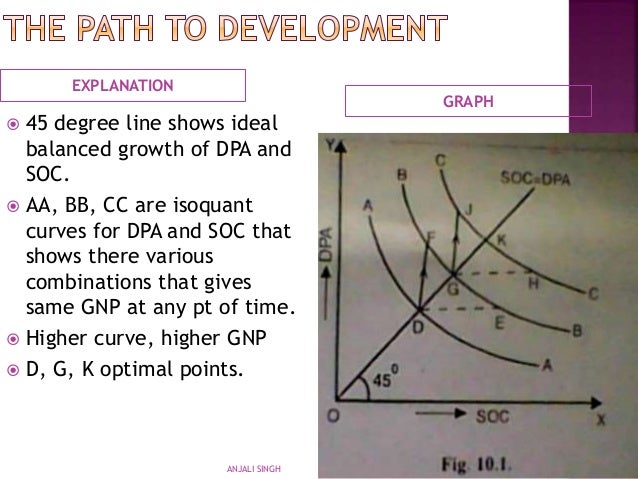
Social Science
In order to clear his views, Nurkse has given example of shoe industry as given by Rosenstein Rodan. It testifies that investment in shoe industry will not lead to sufficient demand. What we need is to have overall investment, so that labourers of one industry can be the consumers or buyers of the products of others.
In the words of Nurkse, “The solution seems to be balanced pattern of investment in a number of different industries so that people working with more productivity, with more capital and improved techniques become each other’s customers.” When investment will be made in several industries simultaneously, it will increase the income of many people who are employed in various industries. They will purchase goods made by each other for consumption. They will become customers mutually.
Thus, with the increase in supply demand will also go up. The extent of market will also increase.
It will lead to capital formation and thus, the vicious circle of poverty will get broken. Same would be the case of wage-earners of different industries or sectors.
The complementarity of industries is in reality, the crux of the concept of balanced growth. This is termed as complementarities of demand. According to Nurkse, “Most industries entering for mass consumption are complementary in the sense that they provide a market for and thus supports each other, the basic complementarity stems, in the last analysis from the diversity of human wants. The case for balanced growth rests on the need for a balanced diet.” Thus, on the basis of the complementaries of demand, balanced growth will be helpful in attaining economic progress.
(ii) Government Intervention: Nurkse is of the view that the government must intervene in productive activities through economic planning. He is of the view that when government participates in productive activities, it will help in breaking the vicious circle of poverty. Nurkse opines that if entrepreneurs are available in underdeveloped countries, then they can be induced to make investment. But in underdeveloped countries, private entrepreneurs cannot come forward with so much heavy investment. This can easily be carried by the government only. Thus, vicious circle of poverty can be broken only by the intervention of the government. (iii) External Economies: Balanced growth also leads to external economies.
Theory Of Balanced Growth By Myint Pdf
External economies are those which accrue because of the setting up of new industries and expansion of the existing industries. The accruing of external economies lead to the law of increasing returns to scale. It leads to a fall in the cost of production and hence the price level. A fall in the price leads to the increase in demand which is useful for economic development.
(iv) Economic Growth: Balanced growth helps in accelerating the pace of economic growth, G.M.Meier is of the view that “Balanced Growth is a means of getting out of rut”. Nurkse is of the view that increase in investment in different branches of production can enlarge the total market.
This can break the bonds of the stationery equilibrium of underdevelopment. How the Market can be enlarged: The market size can be enlarged by monetary expansion, salesmanship and advertisement, removing trade restrictions and expanding social other heads i.e., infrastructures. It can be widened either by a reduction in prices or by an increase in money while keeping constant prices. As the circumstances are found, market is not large enough to allow production on such a scale to reduce cost in underdeveloped countries. The solution pointed out for this critical position by Prof. Nurkse, is “More or less synchronized application of capital to a wide range of different industries. Here is an escape from the deadlock, that is it results in an overall enlargement of the market.
People working with more and better tools in a number of complementary projects become each other’s consumer. More industries catering for mass consumption are complementary in the sense that they provide a market for and support each other.
Sitemap: 1.2.2 Theory of Unbalanced Growth (HIRSCHMAN 9) Contrary to the theory of balanced growth, in Hirschman's opinion, the real bottleneck is not the shortage of capital, but lack of entrepreneurial abilities. Potential entrepreneurs are hindered in their decision-making by institutional factors: either group considerations play a -great role and hinder the potential entrepreneur, or entrepreneurs aim at personal gains at the cost of others and are thus equally detrimental to development. In view of the lack of enterpreneurial abilities there is a need for a mechanism of incentive and pressure which will automatically result in the required decisions. According to Hirschman, not a balanced growth should be aimed at, but rather existing imbalances— whose symptoms are profit and losses—must be maintained. Investments should not be spread evenly but concentrated in such projects in which they cause additional investments because of their backward and forward linkages without being too demanding on entrepreneurial abilities. Manufacturing industries and import substitutions are relevant examples.
These first investments initiate further investments which are made by less qualified entrepreneurs. Thus, the strategy overcomes the bottleneck of entrepreneurial ability. The theory gives no hints as to how the attitude of entrepreneurs and their institutional influence will be changed in time.